

What is the coefficient of friction of spherical oil - impregnated bearings?
Sep 14, 2026
What is the coefficient of friction of spherical oil - impregnated bearings?
As a supplier of Spherical Oil - impregnated Bearings, I often get asked about the coefficient of friction of these bearings. Understanding this concept is crucial for anyone involved in mechanical engineering, manufacturing, or product design. In this blog post, I'll delve into what the coefficient of friction is, how it applies to spherical oil - impregnated bearings, and why it matters in various applications.
Understanding the Coefficient of Friction
The coefficient of friction is a dimensionless quantity that represents the ratio of the force of friction between two surfaces in contact to the normal force pressing the two surfaces together. Mathematically, it is expressed as (μ = F_f/F_n), where (μ) is the coefficient of friction, (F_f) is the frictional force, and (F_n) is the normal force.
There are two main types of coefficients of friction: static and kinetic. The static coefficient of friction ((μ_s)) is the coefficient when the two surfaces are at rest relative to each other, and it represents the minimum force required to start the motion between the surfaces. The kinetic coefficient of friction ((μ_k)) comes into play when the surfaces are in relative motion. Generally, (μ_s>μ_k), meaning it takes more force to start an object moving than to keep it moving.
Coefficient of Friction in Spherical Oil - impregnated Bearings
Spherical oil - impregnated bearings are a special type of bearing that are designed to operate with a layer of lubricating oil within their structure. The oil serves multiple purposes, one of which is to reduce the coefficient of friction between the bearing and the shaft or other mating parts.
The coefficient of friction in spherical oil - impregnated bearings is influenced by several factors. Firstly, the type of oil used for impregnation plays a significant role. Different oils have different viscosities and lubricating properties. For example, a high - viscosity oil may provide better lubrication under heavy loads but could also increase the initial resistance to motion, affecting the static coefficient of friction. On the other hand, a low - viscosity oil may reduce the frictional force during motion but may not be as effective in providing long - term lubrication under high - load conditions.
The material of the bearing itself also affects the coefficient of friction. Spherical oil - impregnated bearings are often made from porous materials such as sintered metal. The porosity of the material allows it to hold the lubricating oil. The surface finish of the bearing can also impact the coefficient of friction. A smoother surface generally results in a lower coefficient of friction as there are fewer irregularities for the mating surface to interact with.
The operating conditions, such as temperature and load, also have a profound effect on the coefficient of friction. At higher temperatures, the viscosity of the oil decreases, which can change the lubricating properties and thus the coefficient of friction. Similarly, under high loads, the oil film between the bearing and the mating surface may be compressed, leading to an increase in the coefficient of friction.
Importance of the Coefficient of Friction in Applications
The coefficient of friction of spherical oil - impregnated bearings is of great importance in various applications. In automotive engines, for example, these bearings are used in components such as camshafts and connecting rods. A low coefficient of friction in these bearings means less energy is wasted in overcoming friction, resulting in improved fuel efficiency and reduced wear and tear on the engine components.
In industrial machinery, spherical oil - impregnated bearings are used in conveyor systems, pumps, and other equipment. A lower coefficient of friction allows the machinery to operate more smoothly and with less power consumption. This not only reduces operational costs but also extends the lifespan of the equipment.
In precision instruments and devices, such as watches and medical equipment, the coefficient of friction needs to be precisely controlled. A stable and low coefficient of friction ensures accurate and reliable operation of these delicate instruments.

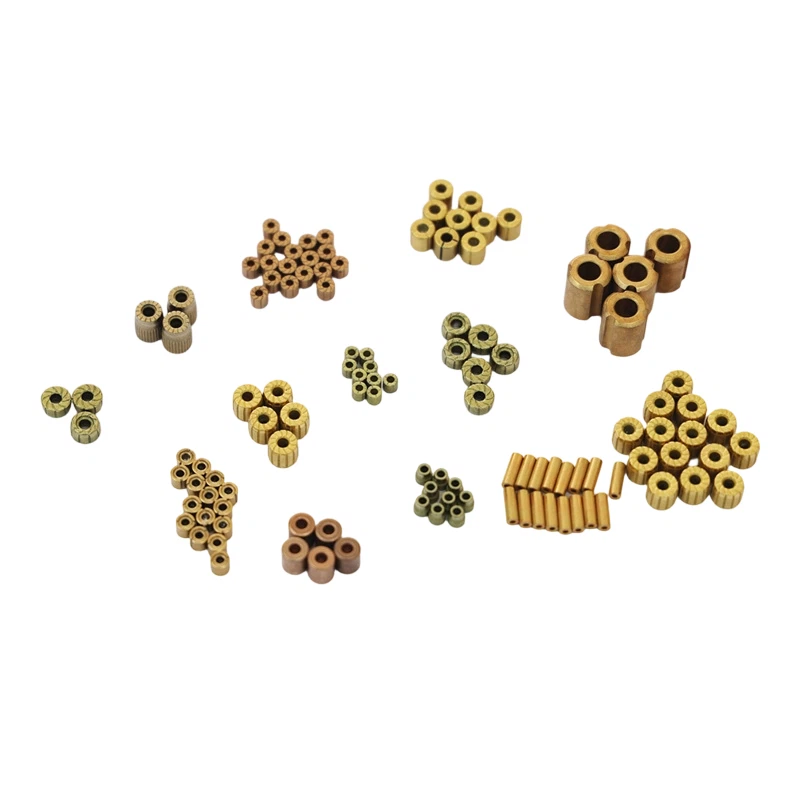
Comparing with Other Types of Bearings
When compared to other types of bearings, such as Hollow Bearings and Sliding Bushing, spherical oil - impregnated bearings have some unique advantages in terms of the coefficient of friction. Hollow bearings may have a different coefficient of friction depending on their design and application. They are often used in applications where weight reduction is a priority, but the coefficient of friction may be higher in some cases due to the lack of a continuous lubricating surface.
Sliding bushings, on the other hand, typically have a higher coefficient of friction compared to spherical oil - impregnated bearings. This is because sliding bushings rely on direct contact between the bushing and the shaft, and the lubrication may not be as effective as in oil - impregnated bearings.
Measuring the Coefficient of Friction
Measuring the coefficient of friction of spherical oil - impregnated bearings is a complex process. Specialized testing equipment is used to apply a known normal force and measure the frictional force between the bearing and a mating surface. The test is usually conducted under controlled conditions, such as a specific temperature and humidity.
The results of these tests can provide valuable information for both the manufacturer and the end - user. Manufacturers can use the data to optimize the design and manufacturing process of the bearings, while end - users can use it to select the most suitable bearings for their applications.
How Our Spherical Oil - impregnated Bearings Stand Out
As a supplier of Spherical Oil - impregnated Bearings, we take pride in the quality and performance of our products. Our bearings are designed to have a low and stable coefficient of friction, which is achieved through a combination of high - quality materials, advanced manufacturing processes, and careful selection of lubricating oils.
We conduct extensive testing on our bearings to ensure that they meet the highest standards of performance. Our research and development team is constantly working on improving the design and materials to further reduce the coefficient of friction and enhance the overall performance of the bearings.
Conclusion
The coefficient of friction of spherical oil - impregnated bearings is a critical factor that affects their performance in various applications. Understanding this concept and its influencing factors is essential for anyone involved in the design, selection, or use of these bearings.
If you are in the market for high - quality spherical oil - impregnated bearings, we invite you to contact us for a detailed discussion. Our team of experts is ready to assist you in selecting the most suitable bearings for your specific needs. Whether you are working on an automotive project, an industrial application, or a precision instrument, we have the right solution for you.
References
- Bowden, F. P., & Tabor, D. (1950). The Friction and Lubrication of Solids. Oxford University Press.
- Bhushan, B. (2013). Principles and Applications of Tribology. Wiley.
- Hutchings, I. M. (1992). Tribology: Friction and Wear of Engineering Materials. Edward Arnold.